Praedium
AI-powered probability of default scoring for commercial real estate loans.
Built for institutional credit teams · XGBoost · Real-time API
What is Praedium
One number that tells you whether to write the check.
Praedium is a machine learning credit risk platform that outputs the probability a commercial real estate loan will default. It processes 15 loan-level parameters through a gradient-boosted XGBoost model and returns a calibrated probability of default score — in real time.
Trained on historical performance
The model learns from thousands of CRE loans across property types, geographies, and market cycles — capturing non-linear feature interactions that linear scorecards miss.
Calibrated risk tiers
The raw PD score is mapped to four risk tiers — Low, Moderate, Elevated, High — calibrated to align with institutional credit policy thresholds and loss distributions.
Feature attribution included
Every score comes with feature-level attribution showing which loan characteristics are driving risk up or protecting credit quality — giving analysts a transparent, defensible model decision.
Who it's for
Credit analysts, portfolio managers, and risk officers at banks, insurance companies, debt funds, and GSEs — institutions that need a consistent, auditable machine learning engine without building or maintaining one in-house.
Model Performance
Validated on real CRE data
Evaluated on a held-out test set. Below: confusion matrix at the 0.75 classification threshold and predicted default probability distribution across performing and delinquent loans.
Confusion Matrix · 0.75 threshold
Model Validation
Confusion Matrix — 0.75 Threshold
Test dataset · XGBoost classifier
Predicted Default Probability · Test Set
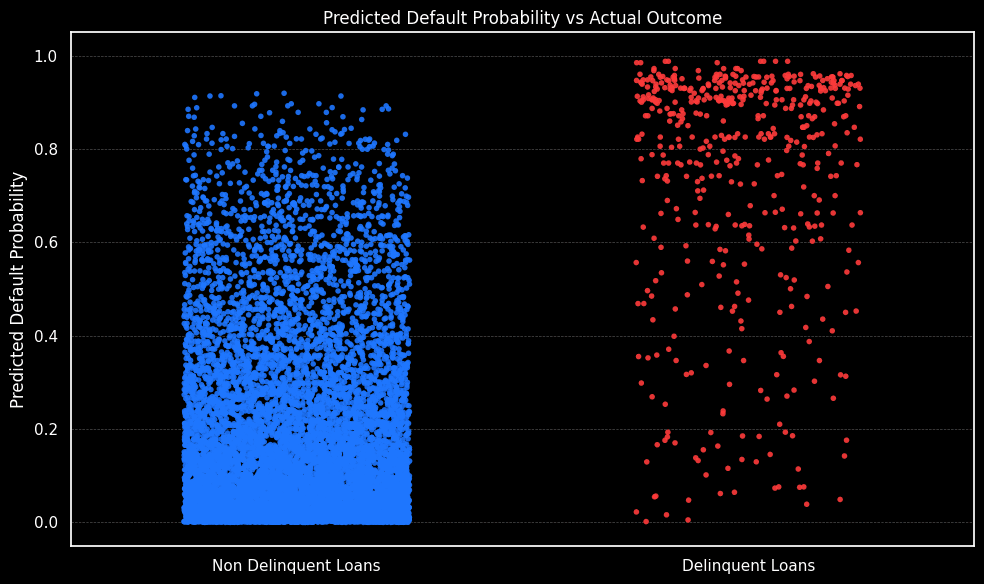
Blue: performing loans (n≈5,000) · Red: delinquent loans (n≈430) · Model concentrates delinquent predictions above 0.75.
Explore Default Features
What drives default risk
Explore how each loan feature correlates with default across the training dataset. Select any feature to see its distribution across performing and delinquent loans.
Debt service coverage ratio at underwriting. DSCR below 1.0x means income cannot cover debt payments — a strong default predictor.
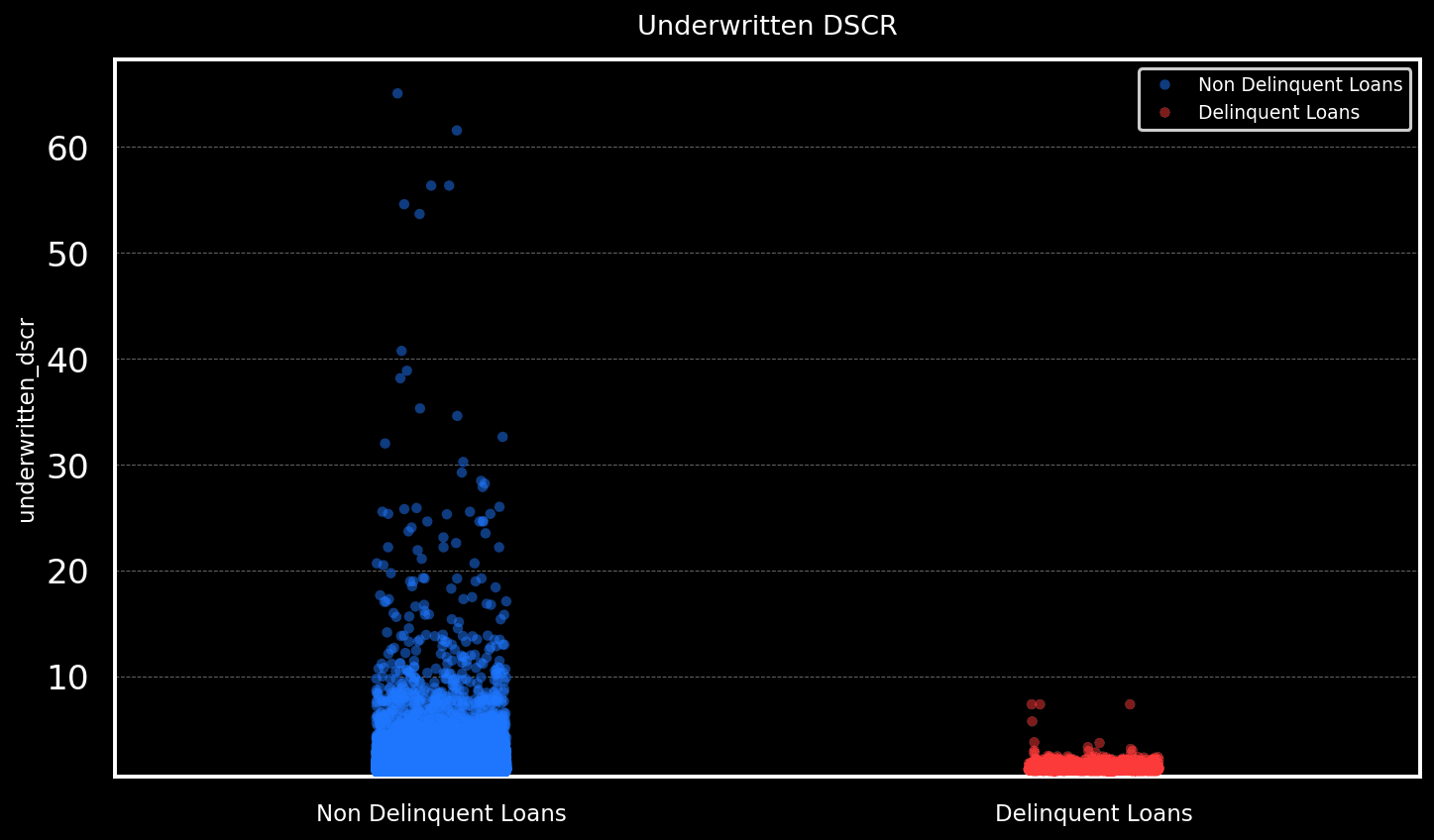
Distribution across held-out test set · Blue = performing · Red = delinquent
Use Cases
Built for institutional credit teams
Praedium integrates into every stage of the CRE credit lifecycle — from origination through exit — giving risk teams a consistent, model-driven view of default probability.
Loan Origination
Score every credit at underwriting. Flag elevated-risk loans before commitment, accelerate low-risk approvals, and standardize decisions across origination desks.
Portfolio Monitoring
Re-score existing loans on a scheduled basis to detect credit migration. Surface early warning signals before delinquency appears in servicer data.
Stress Testing
Simulate rate shocks, occupancy drops, and LTV compression — then recompute PD across the book. Essential for DFAST and internal stress frameworks.
CMBS Due Diligence
Rapidly score loan pools during securitization. Identify tail-risk collateral, support subordination sizing, and generate audit-ready model documentation.
Acquisition Analysis
Underwrite CRE acquisitions with a quantitative default probability layer alongside traditional underwriting metrics and sponsor analysis.
Regulatory Capital
Integrate model-derived PD estimates into CECL reserve calculations, Basel III RWA frameworks, and internal RAROC or economic capital models.
Score your next loan
Enter loan parameters and receive an instant probability of default score, risk tier classification, and feature attribution.